How to Winterize a Motorcycle: The Checklist That Wakes Up Ready
Fuel, battery, tires, chain, fluids, cover. Nine steps, an afternoon's work, and a machine that starts on the first warm Saturday instead of the third.
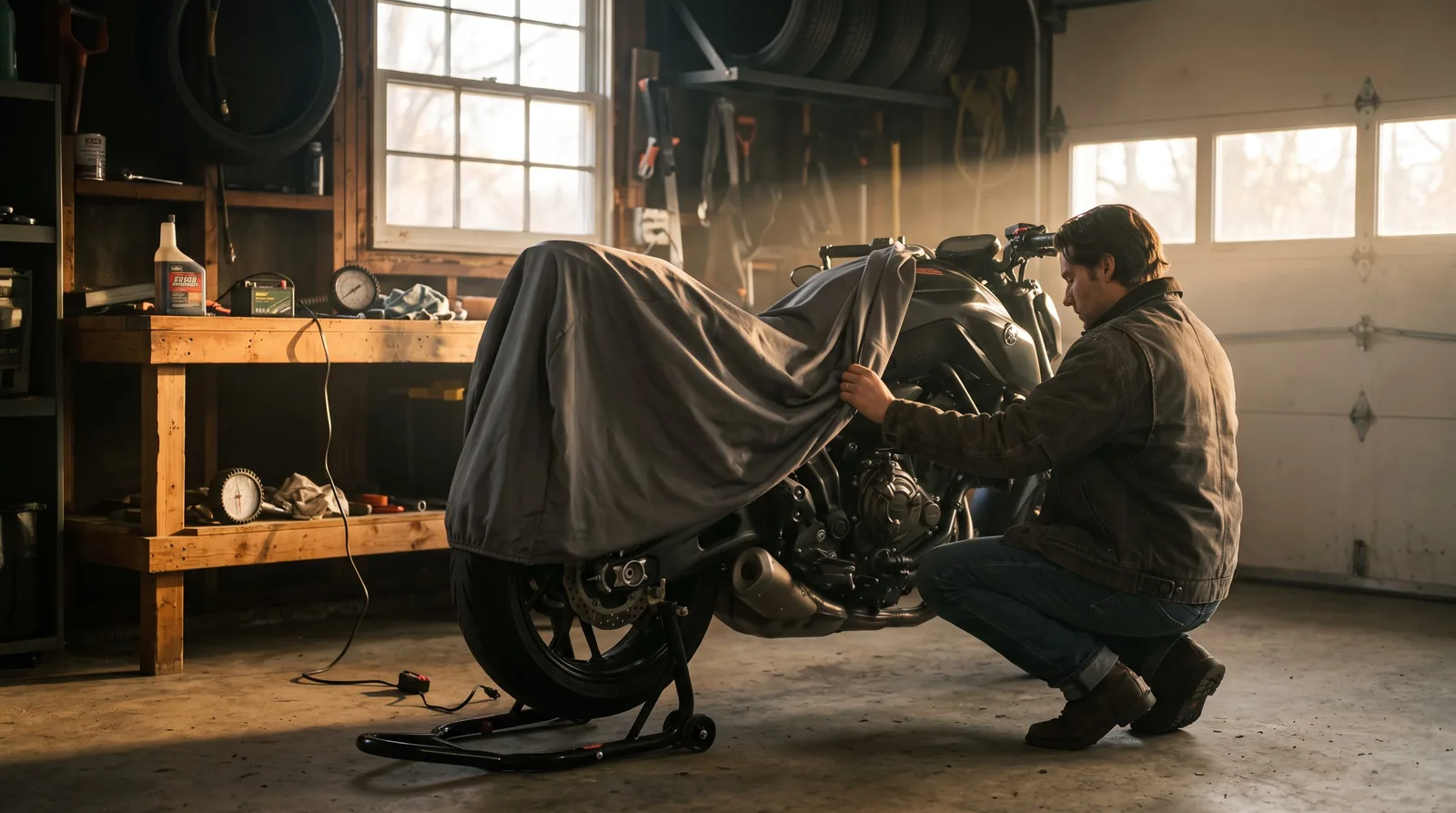
Every spring, the same story plays out in garages across the Northeast. The first warm Saturday. The bike that sat for four months. The click of a dead battery, or the cough of a carb gummed with stale fuel. A whole riding day lost to a problem that took twenty minutes to prevent in November.
This is the checklist. Nine steps, an afternoon. Do them in order, log what you did, and the machine wakes up ready.
If you're storing for six months or longer, read the long-term storage guide as well. If you want the why behind each step, the winter storage guide covers it. This one is the do.
Before you start
What you need: fuel stabilizer, a battery tender, chain cleaner and lube, a basic tool roll, a few rags, tire gauge, a breathable cover. Optional: fogging oil, a center or paddock stand, a bag of rodent deterrent.
When: after your last ride of the season, while the engine is still warm. Warm oil drains clean. A warm engine also burns off moisture.
Where: a dry space, ideally one you can keep above freezing. A garage beats a shed. A shed beats a tarp.
1. Ride it to warm, then fill the tank
Take the last ride. Twenty minutes is enough to get the oil hot and the fuel moving. On the way back, fill the tank to the top. A full tank leaves no room for air, and no air means no condensation forming on the inside of the tank over the winter.
If the bike is carbureted, this matters twice over. Condensation becomes water in the float bowls, and water in the float bowls becomes corrosion.
2. Add fuel stabilizer and run it through
Add stabilizer to the full tank at the ratio on the bottle. Then run the engine for five minutes so treated fuel reaches the carburetors or injectors. Stabilizer only protects fuel it's touching.
Carbureted bikes: after the five minutes, shut the fuel petcock and let the engine run until it stalls. This drains the bowls so there's nothing left to varnish. If your bike has a bowl drain screw, use that instead.
Fuel-injected bikes: the five-minute run is enough. The system is sealed.
3. Change the oil and filter
Used oil holds acids and combustion byproducts. Four months of that sitting on bearing surfaces does more harm than a season of riding. Drain it hot, replace the filter, fill with fresh oil, and run the engine for a minute to coat everything.
Log the mileage. This is the one record you'll want on the first spring service.
4. Battery: tender on, or out
A motorcycle battery left alone loses charge and sulfates. Two choices:
Leave it in, tender on. Connect a smart tender (not a trickle charger) and leave it. A smart tender senses charge level and cycles; a trickle charger cooks it. This is the easiest option if you have power at the bike.
Take it out. Disconnect negative first, then positive. Store it somewhere that stays above freezing, on a tender or charged monthly. A cold concrete floor pulls charge; put it on a shelf.
Either way, note the date and the resting voltage. A healthy battery reads about 12.6 volts at rest. Below 12.4 and it's already losing. If it's three years old or more, this is the winter to budget for a replacement.
5. Chain: clean, lube, slack
Road grit and old lube turn into an abrasive paste over a winter. Clean the chain properly (the full chain guide walks through it), lube it, and check the slack. A chain stored dirty rusts; a chain stored too tight stresses the output shaft bearing.
Shaft drive? Check the gear oil level and skip ahead.
6. Tires: pressure up, weight off
Inflate to the maximum pressure listed on the sidewall, not the riding pressure. Tires lose air over months, and a tire that goes flat under a bike's weight develops a flat spot that sometimes never comes out.
If you have a stand, get the wheels off the ground. If you don't, move the bike a few inches once a month so the same patch of rubber isn't carrying the load all winter.
Note the DOT date code while you're down there. Tires older than five or six years are due regardless of tread. The tire guide covers how to read the code.
7. Wash, dry, protect
Wash the bike. Bug guts and road salt are mildly acidic and they eat paint and chrome slowly over a winter. Dry it completely, including the spots that trap water: under the seat, around the triple tree, inside the fenders.
Wax the painted surfaces. Wipe the chrome and bare metal with a light oil or a corrosion inhibitor. Treat the leather if you have any.
Fogging oil (optional): for carbureted bikes, long storage, or damp spaces. Pull the plugs, spray a short burst of fogging oil into each cylinder, turn the engine over by hand a couple of times, replace the plugs. It coats the cylinder walls so they don't flash-rust.
8. Block the openings
Mice love airboxes and exhaust pipes. Stuff a rag or a purpose-made plug into the exhaust outlets and the airbox intake. Then write "PLUGS IN EXHAUST" on a piece of tape and stick it on the ignition. People forget. Engines don't like it.
A few dryer sheets or a rodent deterrent sachet under the seat and in the airbox area doesn't hurt.
9. Cover it, and log it
Use a breathable cover, never a plastic tarp. Plastic traps moisture against the bike, which is the opposite of what you want. If the bike is outdoors, a weatherproof but breathable cover is worth the money.
Then log it. Date, mileage, what you did, what you noticed. Battery voltage. Tire date codes. The thing you meant to fix. That record is what turns spring prep from a mystery into a checklist.
The winter checklist, in one place
- Last ride, fill the tank
- Stabilizer in, run five minutes, drain carbs if you have them
- Oil and filter
- Battery on a tender or out and stored warm
- Chain cleaned, lubed, slack checked
- Tires to max sidewall pressure, weight off if you can
- Wash, dry, wax, protect bare metal
- Plug the exhaust and airbox, tag the ignition
- Breathable cover, write it all down
What to check monthly
Ten minutes, once a month: battery voltage or tender light, tire pressure, any sign of mice, any new drips under the bike. Roll it a few inches if it's on its wheels.
Spring is already easier
Come March, the spring prep guide picks up where this one leaves off. If you logged the winter work, most of it is just reversing the list: plugs out, battery in, pressures down, fuel checked, a slow first ride.
Common questions
Should I start the bike every few weeks over winter?
No. A short idle doesn't get the engine hot enough to burn off the moisture it creates, so you're adding water to the oil and the exhaust. Either ride it properly for twenty minutes or leave it alone.
Do I really need fuel stabilizer with modern fuel?
Yes. Ethanol-blended fuel absorbs water and begins to break down in about a month. Stabilizer buys you six to twelve months. It's the cheapest step on this list.
Can I winterize outdoors?
You can. Use a weatherproof breathable cover, get the bike off bare ground (a piece of plywood works), take the battery indoors, and check on it more often. A dry shed or a rented corner of a garage is worth looking into for anything you care about.
What about a bike that won't be ridden for a year or more?
Follow this list, add fogging oil, and read the long-term storage guide. Long storage adds a few steps around fuel, brake fluid, and coolant.
Keep reading
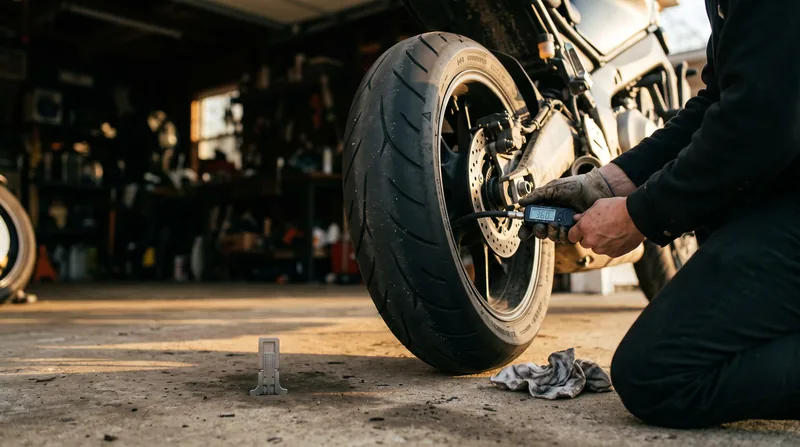 Maintenance & Repairs · 5 min
Motorcycle Tires: Pressure, Wear Bars, Date Codes, and When to Replace
Two patches of rubber the size of your palm are all that touch the road. Here's how to check pressure the right way, read the wear bars and
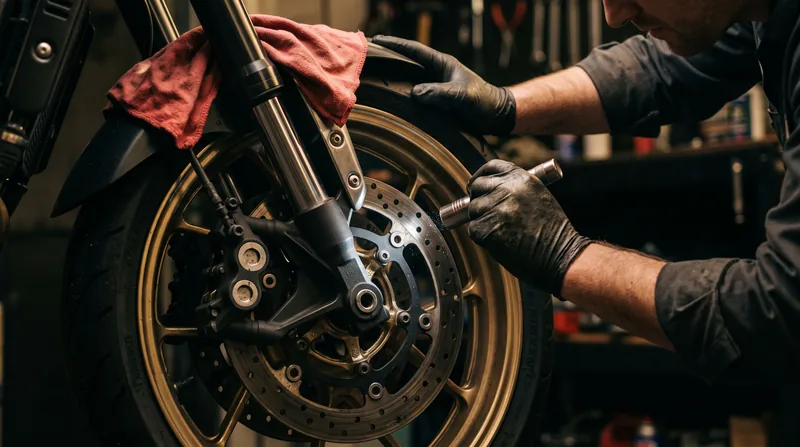 Maintenance & Repairs · 5 min
Motorcycle Brake Inspection at Home: Pads, Fluid, Rotors, and When to Replace
Brakes wear slowly enough that you stop noticing. A ten-minute check with a flashlight tells you what's left, what the fluid's doing, and wh
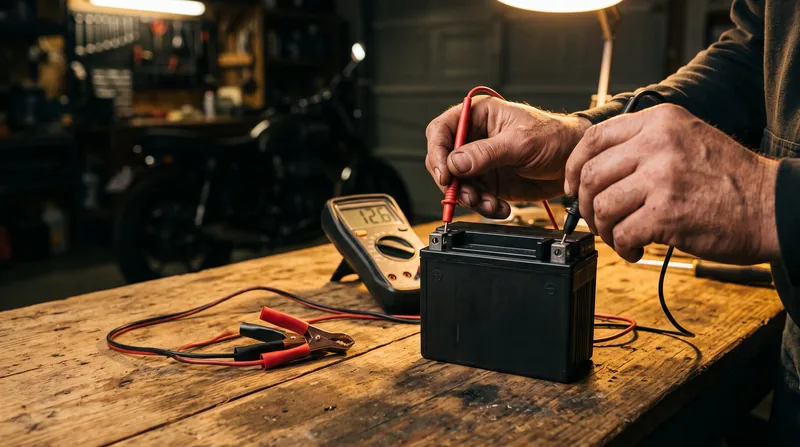 Maintenance & Repairs · 5 min
Motorcycle Battery Maintenance: Tenders, Voltage, and How Long One Lasts
The battery is the part that fails on the first ride of the season. Here's what the voltage numbers mean, which charger to use, how to store