Motorcycle Battery Maintenance: Tenders, Voltage, and How Long One Lasts
The battery is the part that fails on the first ride of the season. Here's what the voltage numbers mean, which charger to use, how to store it, and how to know when it's done.
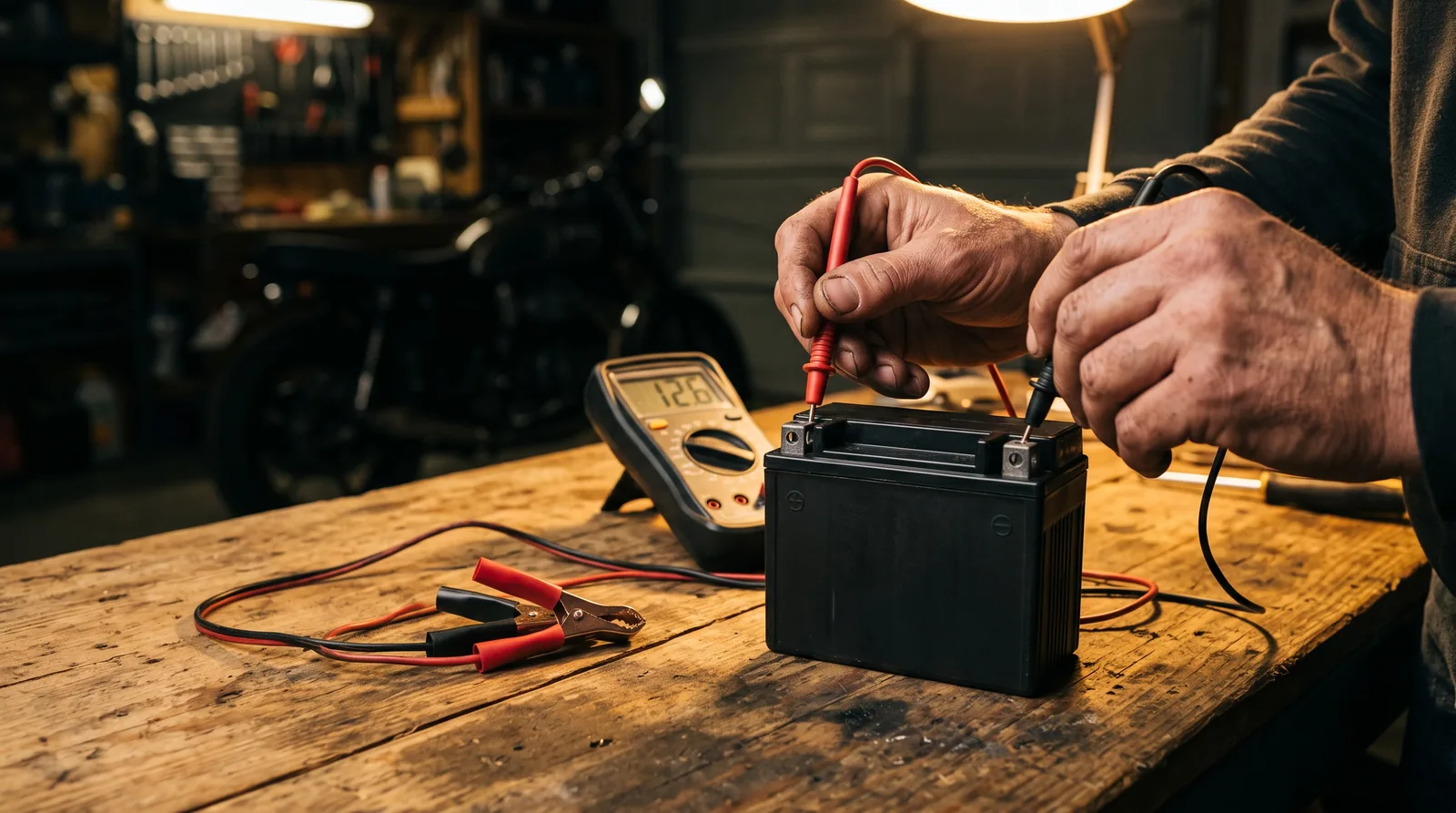
Most motorcycle batteries don't die on the road. They die in the garage, in March, when you turn the key for the first time in four months. The good news is that a battery almost never fails without warning. It tells you, in volts, for weeks. You just have to look.
What the numbers mean
Pull out a multimeter, set it to DC volts, and touch the probes to the terminals with the bike off and the engine cold. For a standard 12-volt lead-acid or AGM battery:
| Resting voltage | What it means |
|---|---|
| 12.7 V or higher | Full. Healthy. |
| 12.5 V | About 75%. Fine, but charge it. |
| 12.3 V | About 50%. Charge it today. |
| 12.0 V | Nearly flat. May not start the bike. |
| Below 11.8 V | Deeply discharged. Sulfating has begun. May not recover. |
Lithium (LiFePO4) batteries read higher: about 13.3 V full, and they fall off a cliff rather than sagging gradually. Check your battery's spec sheet.
Now check it running. At about 3,000 rpm, you should see 13.5 to 14.5 volts at the terminals. Below 13 means the charging system isn't keeping up, and no new battery will fix that. Above 15 means the regulator/rectifier is cooking the battery.
Log both numbers with the date. Two readings a few months apart tell you more than any single one.
Tender, not trickle
A trickle charger pushes a small constant current forever. Left on a motorcycle battery for a winter, it overcharges and boils off the electrolyte.
A battery tender (a smart or maintenance charger) senses the battery's state, charges it to full, then stops and only tops up when it drifts down. This is what you want. Any modern unit from a known brand will do; pick one that matches your battery type, because lithium batteries need a lithium-mode charger.
Connect: red to positive, black to negative or a clean frame ground. Most tenders come with a pigtail you can leave permanently attached to the battery, which makes plugging in a five-second job. Install the pigtail once, route it somewhere you can reach without lifting the seat, and you'll actually use it.
The three types, briefly
Flooded lead-acid. The traditional kind with caps. Cheapest, heaviest, needs the electrolyte checked occasionally, vents gas. Fine on an older bike; replace with an AGM when it dies.
AGM (absorbed glass mat). Sealed lead-acid. No maintenance, no spilling, better vibration resistance, slightly more money. This is what most bikes ship with today and the sensible default.
Lithium (LiFePO4). Half the weight, holds charge far longer in storage, and expensive. Hates cold: below freezing it may need to be "woken up" by turning on the lights for a minute before cranking. Needs a lithium-compatible charger and a healthy charging system. Great on a bike you ride; a mixed bag on a bike that sits.
Why batteries die early
In rough order of how often we see it:
- Sitting discharged. A lead-acid battery below about 12.4 V begins to sulfate. Leave it there for weeks and the sulfate hardens; the battery loses capacity it never gets back. This is what kills most bike batteries, and it's entirely preventable with a tender.
- Heat. A battery in a hot engine bay, in summer, ages faster. Nothing to do about it except know that a four-year-old battery has had a hard life.
- Vibration. Loose mounting cracks plates. Check the hold-down strap.
- A bad charging system. A weak stator or a failed regulator/rectifier either undercharges or overcharges. If you've replaced a battery twice in two years, test the charging system before buying a third.
- Parasitic drain. Alarms, trackers, USB ports and aftermarket accessories pull current with the key off. A few milliamps is normal. Fifty or more will flatten a battery in a couple of weeks.
Storing it over winter
Two options, both fine:
In the bike, on a tender. Easiest, if you have power at the bike. Clip the tender on and leave it. Check the indicator light once a month.
Out of the bike. Disconnect negative first, then positive. Clean the terminals. Store it somewhere above freezing, on a shelf (cold concrete pulls heat and charge out of it). Put it on a tender, or charge it fully once a month. Reconnect positive first, then negative, in spring.
Either way, write down the date and voltage when you put it away. The winterizing checklist has the rest of the storage steps.
Cleaning the terminals
Corrosion on the terminals is a resistor. The bike cranks slowly, the lights dim, and you blame the battery. Disconnect (negative first), scrub the terminals and the cable ends with a wire brush or a paste of baking soda and water, rinse, dry, reconnect (positive first), and put a thin smear of dielectric grease on the terminals to slow it coming back.
How long a battery lasts
A lead-acid or AGM battery that's been kept charged lasts three to five years. One that's been let go flat a few times, two. Lithium can go six or more. If yours is past three and you've noticed slower cranking on cold mornings, that's the sign. Replace it before the season, not during.
Log the install date on the new one. In three years you'll want to know.
What to log in your garage
- Install date and brand of the current battery
- Resting voltage, with date, a couple of times a year
- Running voltage at about 3,000 rpm, once a year
- When it went on the tender for winter
- Anything you added that draws power with the key off
With that record, "is it the battery or the charging system?" is a question you can answer in thirty seconds instead of a weekend.
Common questions
Can I jump-start a motorcycle from a car?
Yes, with the car engine off. Red to the bike's positive, black to a bare metal ground on the bike's frame, then try to start. Never run the car; its alternator can put too much current into a small battery. A lithium jump pack is a better tool to carry.
My battery reads 12.6 V but the bike won't crank. Why?
Voltage shows charge, not capacity. A battery can read full and still not deliver enough current to turn the starter, which means it's worn out internally. A load test at any auto parts store will confirm it.
Should I disconnect the battery for storage even if it's on a tender?
Not necessary. A tender maintains the battery in place, and leaving it connected keeps the clock and any settings. Disconnect only if you don't have a tender or you're storing for a year or more.
Is a lithium battery worth it?
On a bike you ride regularly and want lighter, yes. On a bike that sits through cold winters, the lead-acid-plus-tender combination is more forgiving and costs less.
Keep reading
 Maintenance & Repairs · 5 min
Motorcycle Tires: Pressure, Wear Bars, Date Codes, and When to Replace
Two patches of rubber the size of your palm are all that touch the road. Here's how to check pressure the right way, read the wear bars and
 Maintenance & Repairs · 5 min
Motorcycle Brake Inspection at Home: Pads, Fluid, Rotors, and When to Replace
Brakes wear slowly enough that you stop noticing. A ten-minute check with a flashlight tells you what's left, what the fluid's doing, and wh
 Maintenance & Repairs · 6 min
How to Winterize a Motorcycle: The Checklist That Wakes Up Ready
Fuel, battery, tires, chain, fluids, cover. Nine steps, an afternoon's work, and a machine that starts on the first warm Saturday instead of