
How to Buy a Used Motorcycle Without Getting Burned
The used motorcycle market is full of great deals — and a specific kind of seller who has learned the minimum amount of information needed to sound credible while selling you a problem. Knowing how to inspect a bike before you hand over money separates the riders who get a good deal from the ones who spend the next six months fixing what they just bought.
Here’s what to check, what to ask, and how to read the situation.
Start Before You Show Up: VIN Check and Ad Review
Before you drive anywhere, do two things:
VIN check. Ask for the VIN from the listing. Run it through the NHTSA database (free) for recall history, and through a service like NICB or VINCheck.info to verify it hasn’t been reported stolen or salvaged. A seller who won’t give you the VIN before you show up is a seller worth skipping.
Read the listing carefully. “Runs great” in a headline paired with “as-is, no returns” in the description is a yellow flag. Phrases like “just needs a little work” or “minor issues” deserve clarification before you visit. Ask specifically: what is the little work? What are the minor issues?
At the Bike: Visual Check Before You Start It
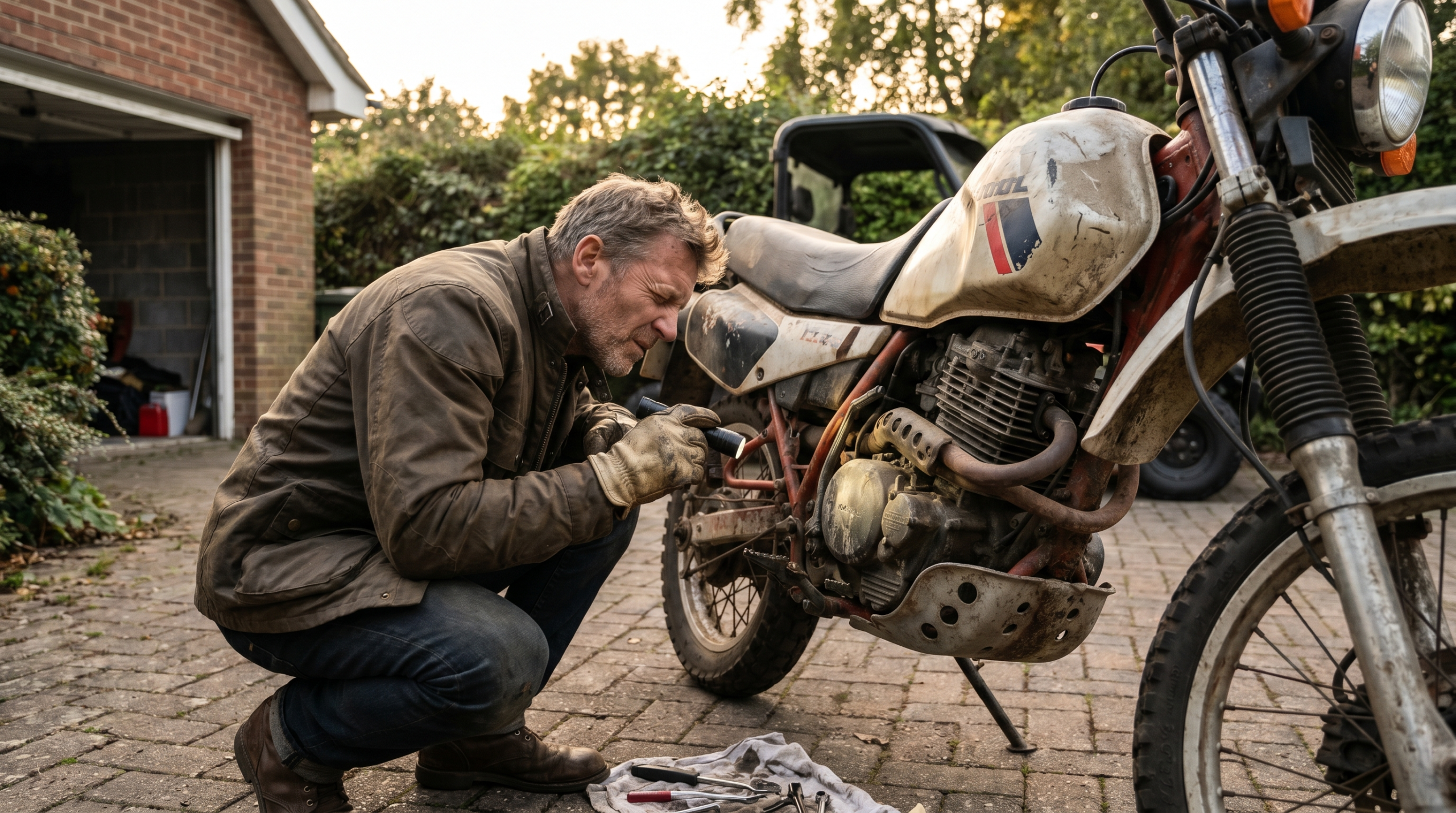
Walk around the bike before anything else is turned on. Cold bike, no explanations, just you and your eyes.
What you’re looking for:
- Crash damage. Bar end damage, footpeg scuffs, fairing cracks or fresh paint over cracks, bent levers, scratched engine cases. Any of these indicate a bike that has been down. One lowside at low speed is not necessarily a problem; multiple crashes or a single high-speed one absolutely are. Ask directly: has this bike been down?
- Frame and welds. Look at the frame rails, swingarm, and steering head for cracks, bends, or repair welds. A repaired frame is a structural issue. Walk away.
- Tire condition. Look at tread depth, sidewall cracking, and wear pattern. Uneven wear can indicate suspension or alignment problems. Old tires (check the DOT date code on the sidewall — last four digits are week/year of manufacture) should be in the price negotiation.
- Fork seals. Look at the lower legs of the front forks. Oil residue = leaking seal. Minor seep = monitor and negotiate; active leak = near-term repair cost.
- Chain or belt. Is it lubricated? Rust on a chain or tension that’s clearly off speaks to maintenance habits across the whole bike.
- Fluids. Check the oil sight glass or dipstick — what color is the oil? Black sludge means it hasn’t been changed in a long time. Look under the bike for fresh drips on the ground.
Cold Start — Don’t Let Them Warm It Up First
Ask the seller not to start the bike before you arrive. A cold start tells you more than a warm one. A seller who “just happened to be warming it up” when you got there is a seller who knows it doesn’t start cold reliably.
What to watch on cold start:
- Does it start without excessive cranking or spraying starting fluid?
- Does it idle smoothly when cold, or does it stumble and die?
- Any smoke from the exhaust? Blue smoke = oil burning. White smoke that doesn’t clear = coolant. Minor white puff on cold startup in cool weather is normal condensation.
- Any rattles, ticks, or knocking from the engine? Minor valve tick can be a simple adjustment; significant engine knock is a major repair.
Let It Warm Up, Then Test Ride
While the bike warms up:
- Check the brake fluid level and condition in both master cylinders
- Test all lights: headlight (high and low), brake light (both lever and pedal), turn signals, horn
- Pull in the clutch — it should feel smooth and consistent
- Test the throttle — full rotation in both directions, snaps back cleanly
On the test ride (which you should always take, and which any legitimate seller will allow):
- Does it pull cleanly through all gears? Gear selection should be positive, not vague
- Does it track straight with hands off the bars at moderate speed? Pulling to one side can indicate frame damage or tire/wheel issues
- Front brake: firm, progressive, not grabby or spongy
- Rear brake: engages smoothly, doesn’t lock up at light pressure
- Any vibrations, wobbles, or handling behavior that feels wrong? Trust your instincts
Ask About the History
These questions tell you as much about the seller as the bike:
- Do you have service records? (No records isn’t automatically disqualifying, but a complete blank is a flag.)
- When was the last oil change? Valve check? Chain replacement?
- Has it been down? Any accidents or damage?
- Why are you selling?
- How long have you owned it?
Inconsistent answers between the listing and what the seller tells you in person are worth noting. A seller who doesn’t know basic service history for a bike they’ve owned for three years is a seller who didn’t do the service.
Negotiation: Know Your Walk-Away Number
Look up comparable sales before you show up. Cycle Trader, Craigslist, and local auction results for similar year/make/model/mileage give you market data. Know the range before you’re standing in someone’s garage.
Issues you find during inspection have dollar values:
- Tires that need replacing: $200–$400 installed for most bikes
- Brake fluid flush: $50–$100
- Fork seal replacement: $150–$300
- Chain and sprockets: $100–$250
Total the work needed and subtract from asking price. A seller who won’t negotiate on a bike with legitimate issues is a seller happy to let you walk — and walking is often the right call.
Start Your Ownership Record the Day You Buy
The moment you take ownership, the clock starts on your service history. What did the bike come with? What needs to be done immediately? What did you pay?
Starting a garage entry in Moto Frontier the day you buy a used bike gives you a clean ownership baseline: purchase price, purchase date, current mileage, and whatever you know about the bike’s history. Everything you do to it from there gets logged. By the time you sell it, you’ll have the documentation that you wished the previous owner had given you.
Start your garage and log your new bike free at Moto Frontier →