
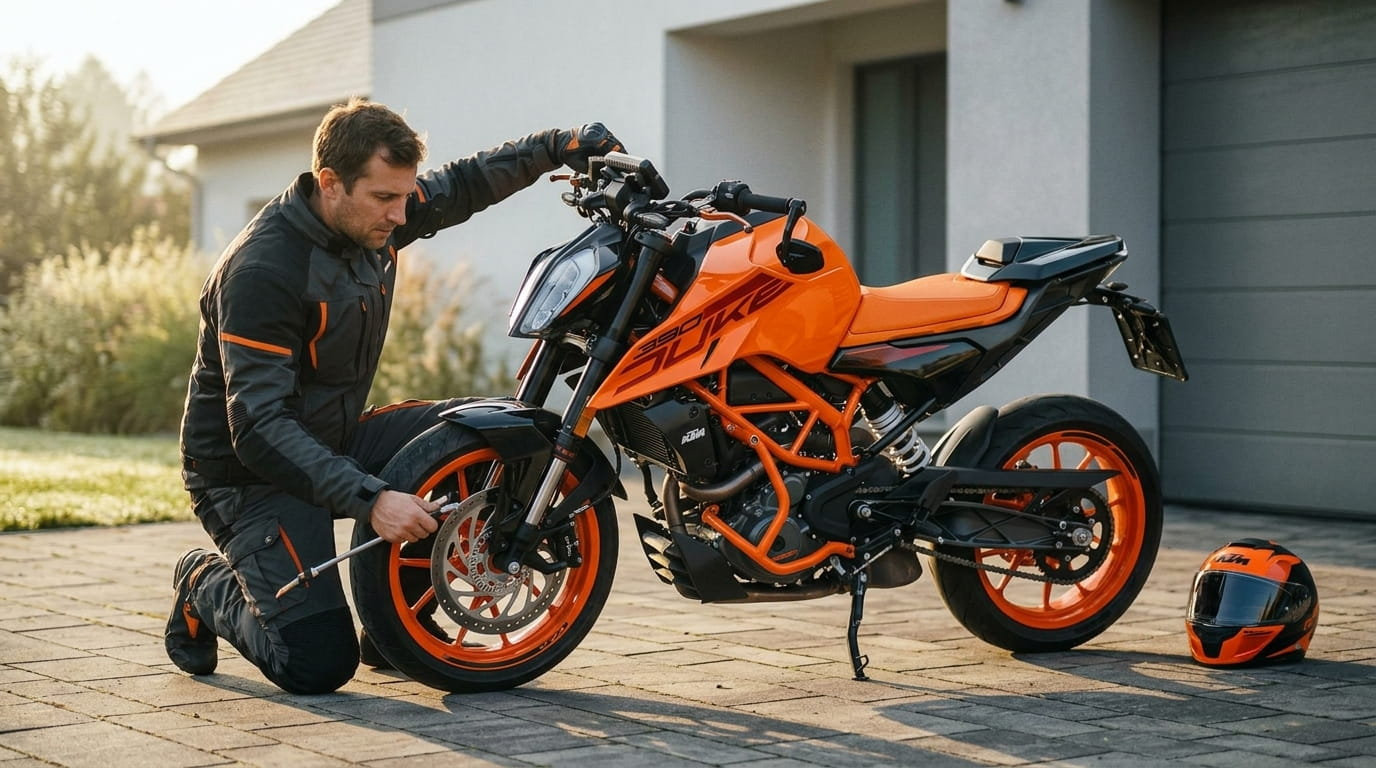
Three minutes. That’s all it takes to walk around your bike before every ride and confirm it’s ready to go. Three minutes that can be the difference between a great day and a catastrophic one.
Most riders skip the pre-ride check. Most riders also have no idea when a problem is quietly developing on their machine. Don’t be that rider.
The T-CLOCS Method
T-CLOCS is the industry-standard pre-ride inspection framework used by the MSF (Motorcycle Safety Foundation). It covers everything that matters in a logical, repeatable sequence.
T — Tires and Wheels
Start here because tires are your only contact with the road.
- Tire pressure: Check cold, before riding. Most bikes call for 32–42 PSI — check your owner’s manual. A 10% drop in pressure significantly affects handling.
- Tread depth: Look for the wear indicator bars. If you’re approaching them, you need new rubber.
- Condition: No cuts, cracks, bulges, or embedded objects (nails, screws).
- Wheels: No missing spokes, no visible wobble, wheel bearings feel smooth.
C — Controls
- Clutch and brake levers: Move freely, not bent or cracked.
- Throttle: Snaps back cleanly when released. No sticking.
- Cables: No fraying, kinking, or binding along the routing path.
- Brake pedal: Proper height and feel, no sponginess.
L — Lights and Electronics
- Headlight (low and high beam)
- Tail light and brake light (both front and rear brake inputs)
- Turn signals front and rear
- Instrument cluster and warning lights (check they illuminate at startup, then clear)
- Horn — yes, check it. It matters.
O — Oil and Other Fluids
- Engine oil: Check the sight glass or dipstick. Between min and max marks, correct color (not milky or black).
- Coolant: If your bike is liquid-cooled, check the reservoir level.
- Brake fluid: Front and rear reservoirs should be at or above the minimum line.
- Fuel: Know your range. Don’t start a ride on fumes.
- Chain lube: Chain should be clean and lightly coated, not dry or caked with grime.
C — Chassis
- Frame: No visible cracks or damage (especially important after a tip-over).
- Suspension: Forks move smoothly without stiction or leaking fork seals. Rear shock no visible leaks.
- Chain tension: Check your owner’s manual for spec — typically 25–35mm of play at the midpoint.
- Fasteners: Quick scan for anything obviously loose or missing.
S — Stands
- Side stand: Retracts fully and the spring holds it up. Many bikes won’t start or will cut out if the stand is down and you’re in gear — but don’t rely on that safety feature alone.
- Center stand (if equipped): Secure and not dragging.
Why Logging Matters
A one-time check is good. A logged check history is better. When you track your pre-ride inspections over time, patterns emerge: the slow leak in that front tire, the brake fluid that keeps dropping. You catch problems before they become failures.
Moto Frontier makes this dead simple. Log your pre-ride checks directly from your phone, attach notes, and build a complete maintenance timeline for your bike. Two minutes after your check. That’s it.
Make It a Habit
The goal isn’t to stress yourself out before every ride. It’s to build a routine so automatic that skipping it feels wrong. Walk the bike. Touch the tires. Check the lights. Glance at the fluids. Get on. Ride.
Three minutes, every time. No exceptions.